乙二、别辨心愿为立行之标准
B2: Criteria Of Differentiation Of (Bodhi) Minds’ Vows For Establishing Practices
心愿八相
[ii] Eight Forms Of Minds’ Vows
然心愿差别,其相乃多,若不指陈,如何趣向?今为大众略而言之,相有其八,所谓邪正、真伪、大小、偏圆是也。云何名为邪正、真伪、大小、偏圆邪?
However, as minds’ vows differ, their forms are thus many, if not pointing out and stating them, how can we know which inclination to follow? Now, for this great assembly, briefly then speaking of their forms, there are these eight, those called [1] evil and [2] right, [3] true and [4] false, [5] great and [6] small, [7] partial and [8] complete. What are named as [1] evil and [2] right, [3] true and [4] false, [5] great and [6] small, [7] partial and [8] complete?
邪菩提心
[1] Evil Bodhi Mind
世有行人,一向修行,不究自心,但知外务,或求利养,或好名闻,或贪现世欲乐,或望未来果报。如是发心,名之为邪。
The world has practitioners, all along cultivating practices, not examining their own minds, only knowing about external matters, perhaps seeking gain, perhaps fond of fame, perhaps greedy for this present life’s desires’ pleasures, perhaps hoping for future fruits of reward. Thus giving rise to the Bodhi Mind, is named as [1] evil.
正菩提心
[2] Right Bodhi Mind
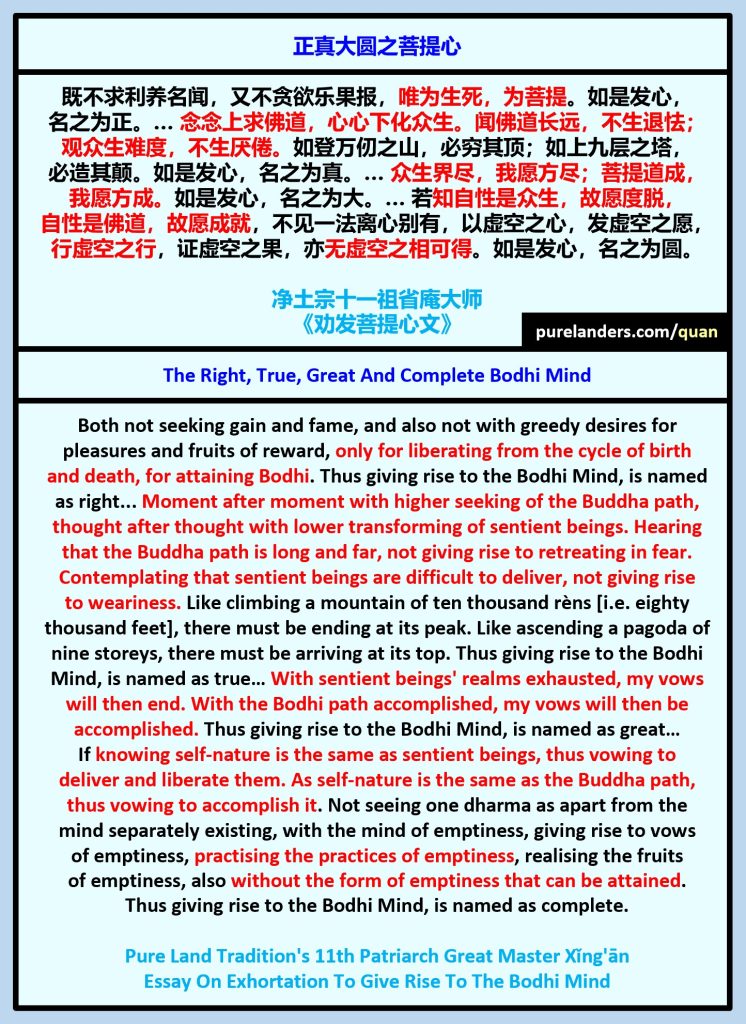
既不求利养名闻,又不贪欲乐果报,唯为生死,为菩提。如是发心,名之为正。
Both not seeking gain and fame, and also not with greedy desires for pleasures and fruits of reward, only for liberating from the cycle of birth and death, for attaining Bodhi. Thus giving rise to the Bodhi Mind, is named as [2] right.
真菩提心
[3] True Bodhi Mind
念念上求佛道,心心下化众生。闻佛道长远,不生退怯;观众生难度,不生厌倦。如登万仞之山,必穷其顶;如上九层之塔,必造其颠。如是发心,名之为真。
Moment after moment with higher seeking of the Buddha path, thought after thought with lower transforming of sentient beings. Hearing that the Buddha path is long and far, not giving rise to retreating in fear. Contemplating that sentient beings are difficult to deliver, not giving rise to weariness. Like climbing a mountain of ten thousand rèns [i.e. eighty thousand feet], there must be ending at its peak. Like ascending a pagoda of nine storeys, there must be arriving at its top. Thus giving rise to the Bodhi Mind, is named as [3] true.
伪菩提心
[4] False Bodhi Mind
有罪不忏,有过不除。内浊外清,始勤终怠。虽有好心,多为名利之所夹杂;虽有善法,复为罪业之所染污。如是发心,名之为伪。
Having transgressions and not repenting for them, having faults and not eliminating them. With inner defilements and outer purity, in the beginning diligent and in the end lazy. Although having a good heart, mostly for fame and gain, with those mixed. Although having good practices, again by transgressive karmas, with those defiled. Thus giving rise to the Bodhi Mind, is named as [4] false.
大菩提心
[5] Great Bodhi Mind
众生界尽,我愿方尽;菩提道成,我愿方成。如是发心,名之为大。
With sentient beings’ realms exhausted, my vows will then end. With the Bodhi path accomplished, my vows will then be accomplished. Thus giving rise to the Bodhi Mind, is named as [5] great.
小菩提心
[6] Small Bodhi Mind
观三界如牢狱,视生死如冤家。但期自度,不欲度人。如是发心,名之为小。
Contemplating the three realms to be like a prison, regarding birth and death to be like enemies. Only looking forward to self-deliverance, not desiring to deliver others. Thus giving rise to the Bodhi Mind, is named as [6] small.
偏菩提心
[7] Partial Bodhi Mind
若于心外见有众生及以佛道,愿度愿成,功勋不忘,知见不泯。如是发心,名之为偏。
If at the mind outside seeing existing sentient beings, and with the Buddha path, aspiring to deliver them, and aspiring to accomplish the path, with meritorious virtues not forgotten, and with wrong knowledge and insights not eliminated. Thus giving rise to the Bodhi Mind, is named as [7] partial.
圆菩提心
[8] Complete Bodhi Mind
若知自性是众生,故愿度脱,自性是佛道,故愿成就,不见一法离心别有,以虚空之心,发虚空之愿,行虚空之行,证虚空之果,亦无虚空之相可得。如是发心,名之为圆。
If knowing self-nature is the same as sentient beings, thus vowing to deliver and liberate them. As self-nature is the same as the Buddha path, thus vowing to accomplish it. Not seeing one dharma as apart from the mind separately existing, with the mind of emptiness, giving rise to vows of emptiness, practising the practices of emptiness, realising the fruits of emptiness, also without the form of emptiness that can be attained. Thus giving rise to the Bodhi Mind, is named as [8] complete.
真正菩提心
[iii] Truly Right Bodhi Mind
知此八种差别,则知审察;知审察,则知去取;知去取,则可发心。
Knowing these eight kinds of differences, then know how to carefully examine them. Knowing how to carefully examine them, then know which to reject and accept. Knowing which to reject and accept, then can there be giving rise to the Bodhi Mind.
云何审察?谓我所发心,于此八中,为邪为正?为真为伪?为大为小?为偏为圆?
How to carefully examine? That called my given rise mind, of these eight within, is it [1] evil or is it [2] right, is it [3] true or is it [4] false, is it [5] great or is it [6] small, is it [7] partial or is it [8] complete?
云何去取?所谓去邪去伪,去小去偏,取正取真,取大取圆。如此发心,方得名为真正发菩提心也。
How to reject and accept? That is called to reject the [1] evil, reject the [4] false, reject the [6] small, reject the [7] partial, and to accept the [2] right, accept the [3] true, accept the [5] great, accept the [8] complete. Thus, thus giving rise to the Bodhi Mind, then is named as [iii] truly right [i.e. genuine] giving rise to the Bodhi Mind.
净土宗十一祖省庵大师
Pure Land Tradition’s 11th Patriarch Great Master Xǐng’ān
《劝发菩提心文》
Essay On Exhortation To Give Rise To The Bodhi Mind
待续 To be continued…
全文
Complete Text:
《劝发菩提心文》
Essay On Exhortation To Give Rise To The Bodhi Mind
https://purelanders.com/quan