Although mythical, the recent cinematic retelling of Homer’s ‘The Odyssey’ missed what is surely a crucial scene, that marked the beginning of Odysseus’ ‘karmic’ retribution, to be condemned to sail and run, lost in circles.
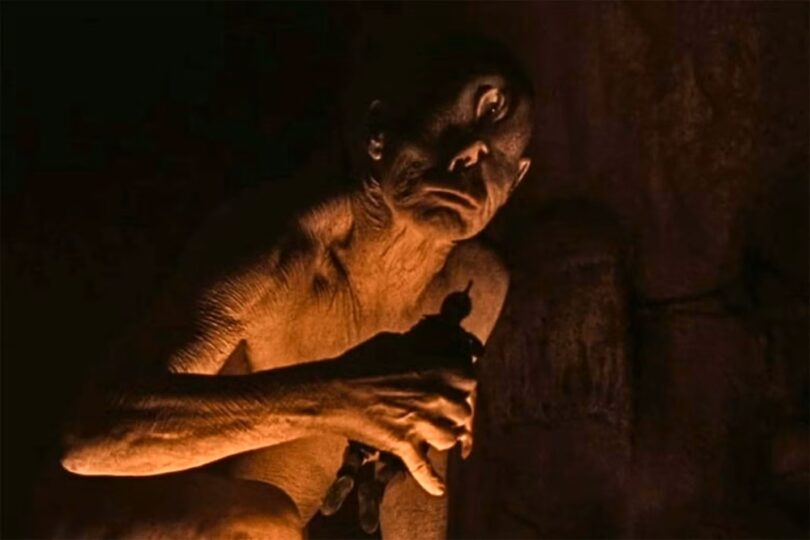
When Odysseus and his men found Polyphemus’ cave, with the cyclops absent, they decided to steal his food. However, Polyphemus returned and sealed the entrance with a giant rock. Odysseus then urged him to receive them generously, to which he scoffed, as he bashed and ate two of the men. As the rock was too big, they could not kill Polyphemus to escape, while they waited in terror.
When Polyphemus left and resealed the cave next morning, they sharpened his club. Upon return, Odysseus offered him his wine, saying his name is ‘Nobody’ (or ‘No One’). Intoxicated, Polyphemus fell asleep. The men then heated the club and used it to gouge out his only eye. Screaming in agony, when other cyclopes ran to his cave to ask who was harming him, as Polyphemus yelled, ‘Nobody!’ (or ‘No One!’), they thus left.
The next morning, when Polyphemus let out his livestock to graze, while feeling them on their way out, Odysseus and his men tied themselves to the bellies of his rams to escape. When they reached their ships, Odysseus yelled to Polyphemus that Zeus (the chief god) will punish him. When farther, Odysseus yelled that should anyone ask, it was he, Odysseus, who blinded him. Thus did Polyphemus beseech his father Poseidon (the sea god), to avenge him.
This is when we should know that Odysseus’ odyssey is not just a challenging ‘hero’s journey’, but a long voyage of personal redemption too.
Thus was Odysseus ‘complicated’,
who is at times a witty hero,
and others a cruel villain.
Thinking Polyphemus should be hospitable
in the name of Zeus’ law (to welcome and help strangers),
he ‘cursed’ him in his name too.
Initially hiding his identity,
but only to beguile,
he finally revealed it, to assert his hubris.
Dissatisfied to be forgotten as a nobody (i.e. no one),
his downfall came from wanting to be somebody (i.e. someone),
himself, to be sung as a famous ‘hero’.
His great pridefulness,
that he mistook for great strength,
was actually his greatest weakness.
The first and true enemy was never Polyphemus,
but Odysseus who plundered and injured,
with his ego and presumptuousness.
Likewise should we reflect,
if the most monstrous monsters are out there
or formless within our self-centred hearts.
Polyphemus had only one eye,
thus perceiving limitedly, even in personal and social morals,
but Odysseus had no excuse with his two eyes!
Related Reviews:
On ‘The Odyssey’ Towards Moral Truths
https://thedailyenlightenment.com/2026/09/on-the-odyssey-towards-moral-truths
Top Ten Lessons ‘Heard’ From The Odyssey’s Siren Song
Link Pending…
Related Article:
The Odyssey: Book 9: Summary & Analysis
https://www.litcharts.com/lit/the-odyssey/book-9