修行中需要注意的十二条原则
Twelve Principles That Need Paying Attention To During Spiritual Cultivation
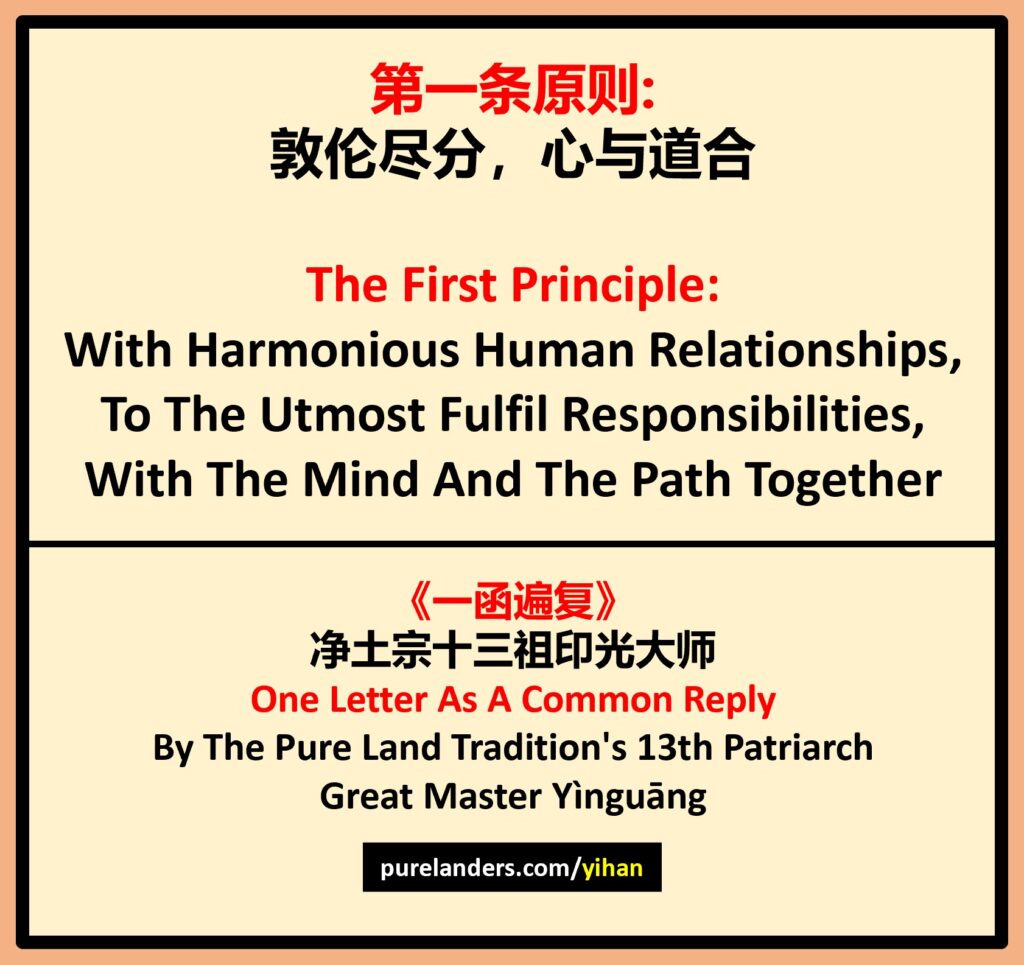
第一条原则:敦伦尽分,心与道合
[1] The First Principle: With Harmonious Human Relationships, To The Utmost Fulfil Responsibilities, With The Mind And The Path Together
念佛之人,必须孝养父母,奉事师长(即教我之师及有道德之人),慈心不杀(当吃长素,或吃花素,既未断荤,切勿亲杀),修十善业(即身不行杀生、偷盗、邪淫之事;口不说妄言、绮语、两舌、恶口之话;心不起贪欲、嗔恚、愚痴之念)。
Of persons with mindfulness of the Buddha, they must have filial support of their Fathers and Mothers, attend to their teachers and seniors, (who are teachers who teach me and persons who have morality), have the mind of loving-kindness to not kill (who should eat as lifelong veg(etari)ans, or eat as flowering veg(etari)ans [on the Six or Ten Purification Days], even if yet to sever from meat, they must not personally kill), cultivate the Ten Good Karmas (which are to have the body not doing matters of killing lives, stealing and sexual misconduct, the mouth not speaking words of false speech, frivolous speech, double-tongued speech and harsh speech, and the mind not giving rise to thoughts of greedy desires, anger and ignorance).
[Note: The Six Purification Days (六斋日) are every lunar month’s 8th, 14th, 15th, 23rd, 29th and 30th day (or 28th day for minor months [小月] without the 30th day). The Ten Purification Days (十斋日) are every lunar month’s 1st, 8th, 14th, 15th, 18th, 23rd, 24th, 28th, 29th and 30th day. On these ‘days’, for one day and night (一日一夜), there are practices of eating as veg(etari)ans (吃素), also observing the Eight Precepts (八戒) of abstaining from (1) killing lives (不杀生), (2) stealing (不偷盗), (3) sexual conduct (不淫), (4) false speech (不妄语), (5) drinking alcohol (i.e. consuming intoxicants) (不饮酒), (6) wearing perfumes, flowers and garlands, applying fragrant oils on the body (不着香花鬘,不香油涂身), (7) sitting (and lying) on high, broad and big (chairs and) beds (不坐高广大床), singing, dancing, having entertainment, going to see or hear such (不歌舞倡伎,不往观听), and (8) untimely eating (不非时食).]
又须父慈子孝,兄友弟恭,夫和妇顺,主仁仆忠,恪尽己分。
Also needed are Fathers and Mothers with loving-kindness, and children with filial piety, elder brothers with friendly affection and younger brothers with respect, husbands with harmony and wives with compliance, masters with benevolence and servants with loyalty, respectfully to the utmost fulfilling one’s responsibilities.
不计他对我之尽分与否,我总要尽我之分。能于家庭及与社会尽谊尽分,是名善人。
Not regarding how others are towards me, to the utmost fulfilling their responsibilities or not, I nevertheless will to the utmost fulfil my responsibilities. Those able to, with family and society, to the utmost with friendship, to the utmost fulfil their responsibilities, are named as good persons.
善人念佛求生西方,决定临终即得往生。以其心与佛合,故感佛慈接引也。
Good persons who are mindful of the Buddha to seek birth in his Western Pure Land, will definitely, when approaching life’s end, immediately attain rebirth there. With their minds and the Buddha together, thus connecting to the Buddha, with loving-kindness receiving and guiding them.
若虽常念佛,心不依道,或于父母兄弟、妻室儿女、朋友乡党不能尽分,则心与佛背,便难往生。以自心发生障碍,佛亦无由垂慈接引也。
If although constantly mindful of the Buddha, but with minds not relying on the path of practice, perhaps with Fathers, Mothers, brothers, sisters, wives, husbands, sons, daughters, friends and fellow villagers, not able to fulfil their responsibilities, thus with their minds and the Buddha contrary to each other, it is then difficult to be reborn there. With one’s mind giving rise to obstacles, the Buddha is also not able to approach with loving-kindness to receive and guide them.
净土宗十三祖印光大师
Pure Land Tradition’s 13th Patriarch Great Master Yìnguāng
《一函遍复》
One Letter As A Common Reply