From Great Master Hóngyī’s (弘一大师) ‘Discussion On Experiments For Correcting Faults’《改过实验谈》:
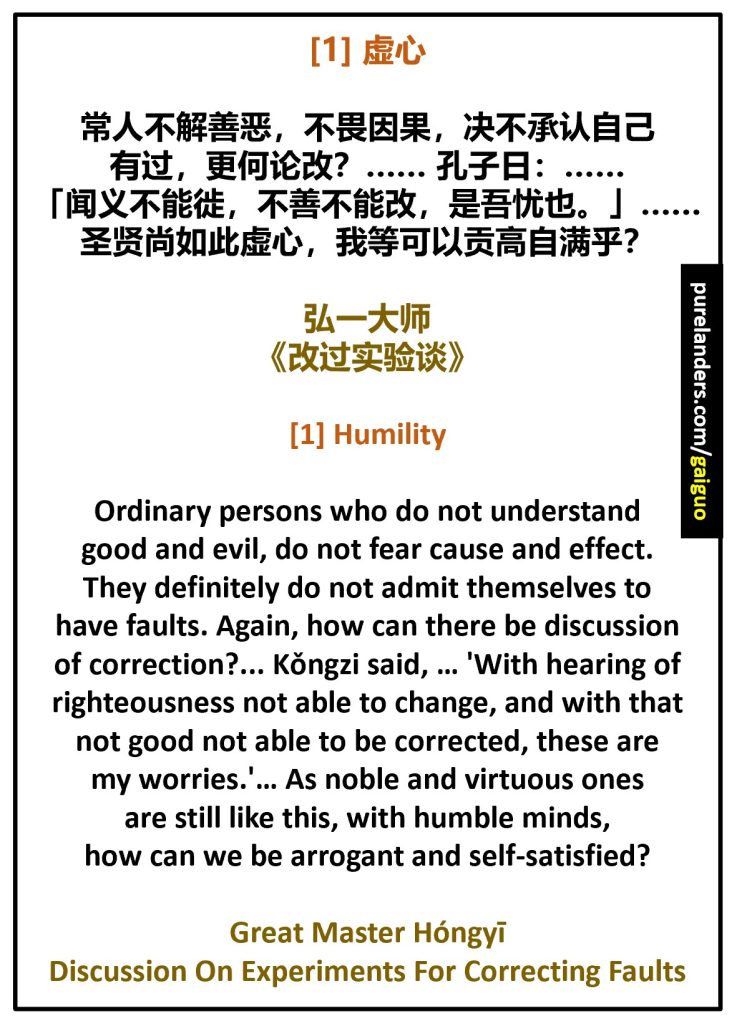
1、虚心:常人不解善恶,不畏因果,决不承认自己有过,更何论改?但古圣贤则不然。今举数例:
[1] Humility: Ordinary persons who do not understand good and evil, do not fear cause and effect. They definitely do not admit themselves to have faults. Again, how can there be discussion of correction? However, ancient noble and virtuous ones are then not thus. Now raising several examples.
孔子日:「五十以学易,可以无大过矣。」又日:「闻义不能徙,不善不能改,是吾忧也。」
Kǒngzi [Confucius] said, ‘With fifty years for further learning the Book Of Changes《易经》, I can be without great faults.’ Also saying, ‘With hearing of righteousness not able to change, and with that not good not able to be corrected, these are my worries.’
蘧伯玉为当时之贤人,彼使人于孔子。孔子与之坐而问焉,曰:「夫子何为?」对曰:「夫子欲寡其过而未能也。」
Qú Bóyù, as a virtuous person of that time, had that dispatching of a person to go to Kǒngzi. Kǒngz with him sat and asked this, saying, ‘How is the Master doing?’ In reply, ‘The Master desires to reduce his faults, but is yet to be able to do so.’
圣贤尚如此虚心,我等可以贡高自满乎?
As noble and virtuous ones are still like this, with humble minds, how can we be arrogant and self-satisfied?
Note 1: Due to ignorance and delusion (愚痴), many common people might at most have vague, biased and thus inaccurate personal definitions of what constitutes good and evil (善恶). In the Buddha’s teachings, what arises in thought, word and deed (身口意) with the three poisons (三毒) of greed, hatred and delusion (贪嗔痴) are considered evil, while those with their counterparts, the ‘three antidotes’ (三药) of generosity (布施), compassion (慈悲) and wisdom (智慧) are considered good.
If without clear knowledge of good and evil, there is naturally, also at most, murky or incomplete ‘faith’ in the karmic power (业力) of cause and effect, with confused beliefs on what creates good karmas (善业) (i.e. three antidotes) and evil karmas (恶业) (i.e. three poisons). Those with severely wrong or no knowledge of good and evil, and thus with corresponding misunderstanding or no understanding of good and evil karmas, will find it challenging to recognise their faults properly, what more to amend them completely.
Although Confucius (孔子) was the founder of Confucianism (孔教) itself, he admitted that there was much more to learn in his final years, to be free from major transgressions, including through the Book Of Changes, which is a classic from Taoism (道教). Surely, he would have seen the need to learn Buddhism (佛教) too, had he encountered it in his time, as it has detailed teachings on various sets of moral precepts for discipline (戒律), all geared towards final impeccable faultlessness.
Those who aspire to be ever more virtuous and noble are constantly concerned about improving themselves in thought, word and deed, so as to reach moral perfection. That which they are ‘anxious’ about and ‘fret’ over is reluctance, laziness and ‘inability’ to improve, thus being morally unamendable and spiritually stagnant. However, all can indeed change for the better, as long as willing and diligent in continual learning and practice.
On the path to be ‘ever’ more virtuous and noble, as long as we are yet to be Buddhas, exactly since we are not yet good or pure enough, we must retain humility to keep learning and practising well, without pridefulness and complacence. Otherwise, our progress will cease, and any progress so far is likely to be lost with retrogression (退转) in time.
Even with the attainment of Buddhahood (佛果), the Buddhas would have realised non-self (无我) completely, thus being free from all sense of attachment to self. Just when they seem to have ‘everything’ to be proud of, they have no self to be proud with at all. This is one of the reasons that make them great and perfect, why we revere them, and aspire to be like them!
完整教理
Complete Teachings:
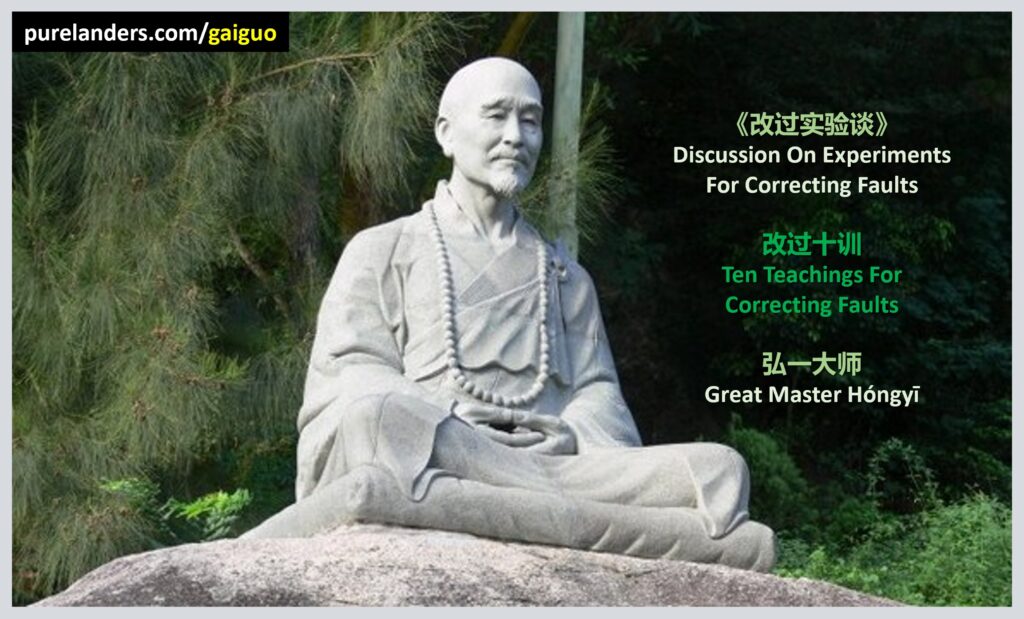
《改过实验谈》
Discussion On Experiments For Correcting Faults
https://purelanders.com/gaiguo