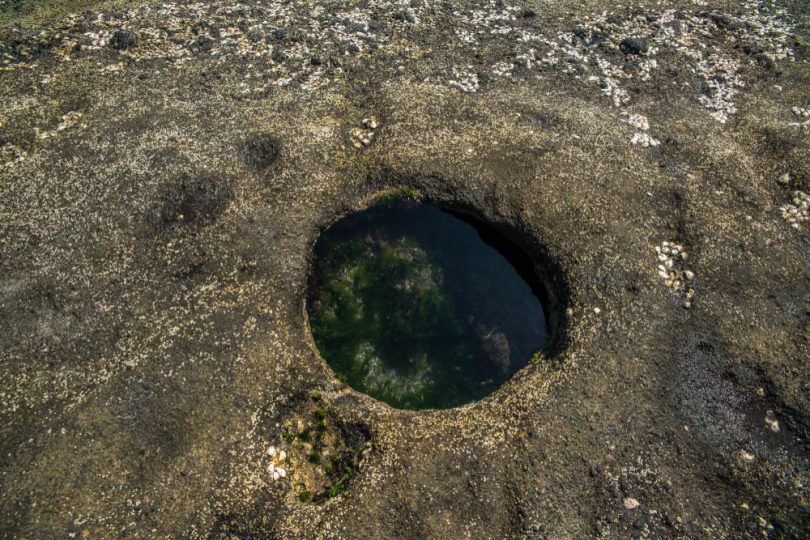
昔有一人与他妇通,交通未竟夫从外来,即便觉之住于门外,伺其出时便欲杀害。
In the past, there was a person with another person’s wife committing adultery. With intercourse yet to be complete, the husband from the outside came. Immediately aware of him, he stood at the door outside, waiting for him to come out, then desiring to kill him.
妇语人言:「我夫已觉,更无出处,唯有摩尼可以得出(摩尼者齐云水窦孔也)。」
The wife spoke to the person, saying, ‘As my husband is already aware, you are further, without a place to go out. Only with the maṇi can you get a way out. (That “maṇi” is similar to saying “water burrow’s hole too.”)’
[Note 1: A maṇi (摩尼) in terms of a treasure gem (宝珠) is able to fulfil wishes.]
欲令其人从水窦出,其人错解谓摩尼珠,所在求觅而不知处,即作是言:「不见摩尼珠我终不去。」须臾之间为其所杀。
Desiring to lead that person to be from the water burrow getting out, that person wrongly understood that said to be a maṇi gem. At that place seeking it, yet not knowing the place, he then made this statement, ‘If not seeing the maṇi gem, I, in the end, cannot go.’ In a moment between, he was by him that killed.
凡夫之人亦复如是。有人语言:「生死之中无常苦空无我,离断常二边,处于中道,于此中过可得解脱。」
Of ordinary beings’ people, they are likewise thus. There are people saying, ‘Within that cycle of birth and death, it is with impermanence, suffering, emptiness and without self. Departing from nihilism and eternalism, these two extreme sides, abide on the Middle Path. On this Middle Path crossing can there be attainment of liberation.’
[Note 2: Basically, nihilism (断见) is the extreme (and wrong) view that after this life ends, there will be absolute nothingness, in terms of karmas (业) or rebirths (轮回). Eternalism (常见) is the other extreme (and also wrong) view that after this life ends, there will be permanent ‘somethingness’, in terms of eternal heaven or eternal hell. There can be variations in beliefs of what is lasting or not.]
[Note 3: The Middle Path (中道) between nihilism, (which believes the consciousness ends in death) and eternalism, (which believes the consciousness remains in a fixed state after death), is the truth that there is continual changing of the consciousness, (thus not with it ending to become nothing at all, thereby refuting nihilism, or with it remaining as something fixed forever, thereby refuting eternalism).]
凡夫错解,便求世界有边无边及以众生有我无我,竟不能观中道之理,忽然命终,为于无常之所杀害,堕三恶道,如彼愚人推求摩尼为他所害。
Ordinary beings with wrong understanding, then seek to know if the world has boundaries or no boundaries, and with sentient beings having self or no self. In the end not able to contemplate principles of the Middle Path, suddenly when life ends, by that of impermanence as those killed, falling into the three evil paths, they are like that foolish person inquiring on the maṇi, by another that harmed.
[Note 4: The three evil paths (三恶道) are the (i) hell-beings’ path (地狱道), (ii) hungry ghosts’ path (饿鬼道) and (iii) animals’ path (畜生道).]
全百喻
All Hundred Parables:
https://purelanders.com/baiyu