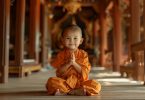
Restlessness is due to
trying to find the constant
within the truly inconstant.
Shilashanti (Part 1)
Even among Buddhists, not many are aware of the deeper meanings of bardo (中阴) states. These are usually only understood as the single intermediate state of being between the expiry of this life and entry into the next life. However, this is only one of the six bardos (六中阴) we enter, one after another, as long as we have yet to attain liberation. Here they are, in sequence…
[1] Bardo of this life (此生中阴): This is the transitional state from birth till death we are within now, during which we have the most opportunities to learn and practise the Dharma for bettering the quality of our future states.
[2] Bardo of meditative concentration (禅定中阴): This is the transitional state we are within when in deep concentration.
[3] Bardo of sleeping and dreaming (睡梦中阴): This is the transitional state we are within when sleeping and/or dreaming.
[4] Bardo of dying (临终中阴): This is the possibly painful and disturbing transitional state we are within when dying, especially if lacking in Dharma practice, when our physical aggregates are dissolving and mental aspects are transforming.
[5] Bardo of Dharmata (Dharma-nature) (法性中阴): This is the transitional state of the Dharmakaya’s (i.e. Universal Body [法身]) luminosity with the bright light of our Buddha-nature (佛性) after death, when the consciousness separates from the body. The experience of this pure light is however very short-lived, unnoticed by most, thus not easy to become one with.
As the best alternative, with the sincere Practice (行) of mindfulness of Buddha’s (念佛) name (Āmítuófó: 阿弥陀佛) with deep Faith and Aspiration (信愿), we will be able to connect to him, who will empower us to see him and his Buddha light (佛光), which carries blessings for bridging us across, to reach his Pure Land (净土). It is there that we will realise the potential of our Buddha-nature fully, progressing to Buddhahood without fail.
[6] Bardo of becoming (投生中阴): This is the transitional state before the consciousness moves on to take shape as a new physical form, as in becoming reborn, (unless reborn in a formless heaven). From this state, we then loop back to the first ‘bardo of this life’ in the next life. (The ‘Alice in Borderland’ drama/manga series is supposed to portray this sixth bardo state, albeit not totally accurately, if referenced with the Dharma.)
Since these six states are cyclical, we are always within one of them, yet to be liberated (解脱) with actual peace and bliss (安乐). Due to the universal characteristic of the impermanence (无常) of mind and matter, we are always transforming and transiting within and between these states. While ‘we’ are changing from moment to moment, our true nature that is our Buddha-nature is constant, awaiting to be discovered, to be permanently realised.
(Thus, we are always holding the ‘wild card’, the ‘joker’, as we are always living and dying within bardo states, in the in-betweens as ‘borderline cases’. We choose what to make this card of ‘now’ stand for, which is no joke or game at all. Just as the joker cards fill the gaps between a deck of white and black cards, we too fill the gaps of life and death, with our deliberated thoughts, words and deeds, for better or worse.
There is a nihilistic [断见] misconception in the series, which suggests that life is painful with trials to endure, while there is no pain and suffering [痛苦], but also no happiness in death. As death and the post-death bardo states are not utter nothingness, with life of the consciousness karmically continuing in different ways, there can be pain, suffering and happiness after death too. In fact, with proficient Pure Land practice, we will be able to experience Ultimate Bliss [极乐] in Pure Land.)
Restfulness is due to
having found the constant
that is truly constant.
Shilashanti (Part 2)