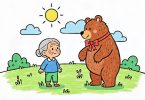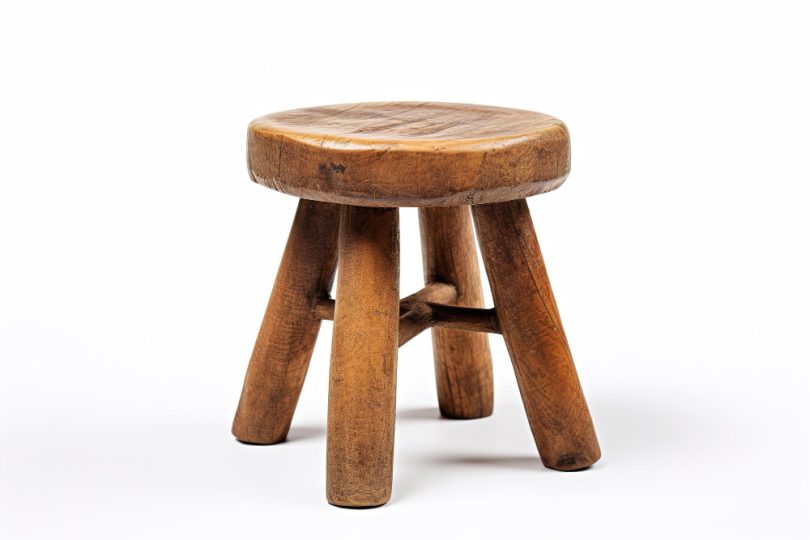
昔有一王,欲入无忧园中欢娱受乐,敕一臣言:「汝捉一机,持至彼园我用坐息。」
In the past, there was a King, desiring to enter Sorrowless Garden within for amusement to receive joy, who ordered a minister, saying, ‘You should for me clutch a low stool, hold it until reaching that garden, for me to use, for sitting and resting.’
时彼使人羞不肯捉,而白王言:「我不能捉,我愿担之。」
Then, that servant was shy and not willing to clutch it , then to the King saying, ‘I am not able to clutch it, but I am willing to shoulder it.’
时王便以三十六机置其背上,驱使担之至于园中。
Then, the King then with thirty-six low stools placed on his back above, ordered him to shoulder them, until reaching of the garden within.
如是愚人为世所笑,凡夫之人亦复如是,若见女人一发在地,自言持戒不肯捉之;后为烦恼所惑,三十六物发毛爪齿屎尿不净不以为丑,三十六物一时都捉不生惭愧,至死不舍,如彼愚人担负于机。
Thus, the foolish person was by the world that laughed at. Of ordinary beings’ people, they are likewise thus, if seeing a woman’s one hair on the ground, personally saying they uphold precepts and are not willing to clutch it, later by afflictions those confused, with the thirty-six objects, of hair, nails, teeth, excrement and urine impure, not with them as ugly, with the thirty-six objects at once all clutched, not giving rise to shame, until death not willing to let them go, they are like that foolish person with shouldering of the low stools.
[Note 1: The thirty-six (impure) objects (三十六物) (of the body) are (i) external forms’ twelve objects (外相十二物), of (1) head hair (发), (2) body hair (毛), (3) nails (爪), (4) teeth (齿), (5) eye gum (眵), (6) tears (泪), (7) saliva (涎), (8) spittle (唾), (9) excrement (屎), (10) urine (尿), (11) dirt (垢), (12) sweat (汗), (ii) body organs’ twelve objects (身器十二物), of (13) outer skin (皮), (14) inner skin (肤), (15) blood (血), (16) flesh (肉), (17) tendons (筋), (18) blood vessels (脉), (19) bones (骨), (20) marrow (髓), (21) fat (肪), (22) grease (膏), (23) brain (脑), (24) membrane (膜), (iii) twelve objects within held (内含十二物), of (25) liver (肝), (26) gallbladder (胆), (27) intestines (肠), (28) stomach (胃), (29) spleen (脾), (30) kidneys (肾), (31) heart (心), (32) lungs (肺), (33) organs with undigested food (生脏), (34) organs with digested food (熟脏), (35) red phlegm (赤痰) and (36) white phlegm (白痰).]
[Note 2: To pretend to be strictly without attachment to any part of the body while actually having much attachment to the body on the whole is being spiritually dishonest to oneself and others.
Not only is this not beneficial to anyone, it can also mislead everyone, including oneself, into thinking one is spiritually advanced, thus not truly progressing in time.
When it turns out that there is still much attachment to the impure body on the deathbed, there will be rebirth in a realm with impure bodies again, as subjects of attachment and lust.]
全百喻
All Hundred Parables:
https://purelanders.com/baiyu